

How Much Does Crawl Space Encapsulation & Vapor Barrier Cost in New Braunfels?
Crawl Space Encapsulation & Vapor Barrier services in New Braunfels, TX typically run between $3,800 and $8,500 for a standard residential crawl space, with most homeowners in the area landing somewhere around $5,200 to $6,400 depending on square footage, moisture conditions, and whether existing insulation needs to come out first. A vapor barrier-only installation – without full encapsulation – is a narrower scope and generally costs $1,200 to $2,800. Both figures assume a clean, accessible crawl space; if there’s standing water, mold, or damaged blocking, expect additional remediation costs before encapsulation can begin.
Crawl Space Encapsulation & Vapor Barrier Cost Breakdown (2026)
Below are the line-item ranges we see in the New Braunfels market as of 2026. These are real job figures – not national averages pulled from a database. The Hill Country’s clay-heavy soils and the moisture that backs up against foundations during heavy Guadalupe River flood seasons make this market meaningfully different from a dry West Texas market, and pricing reflects that.
| Scope of Work | Typical Cost Range (New Braunfels, 2026) |
|---|---|
| Vapor barrier only (6-mil poly sheeting, ground cover) | $1,200 - $2,800 |
| Heavy-duty vapor barrier (20-mil reinforced liner, ground cover) | $2,200 - $4,200 |
| Full crawl space encapsulation – basic (liner + sealed vents + tape seams) | $3,800 - $5,500 |
| Full encapsulation – standard (liner + sealed vents + rim joist foam + drainage matting) | $5,000 - $7,200 |
| Full encapsulation – complete (all above + dehumidifier + sump pump if needed) | $6,500 - $10,500+ |
| Old insulation removal from crawl space floor joists | $800 - $1,800 (add-on) |
| Spray foam insulation to rim joists (after encapsulation) | $600 - $1,400 (add-on) |
| Mold treatment / antimicrobial spray pre-encapsulation | $400 - $1,200 (add-on) |
| Crawl space dehumidifier (installed, commercial-grade) | $900 - $2,200 (add-on) |
| Sump pump installation | $700 - $1,800 (add-on) |
The single biggest cost driver we see in New Braunfels is Crawl Space Insulation height and access. Homes built on pier-and-beam foundations in older neighborhoods like Landa Park and Downtown New Braunfels tend to have tighter, shallower crawl spaces than newer construction in Vintage Oaks or Gruene Estates, and that restricted workspace adds labor hours. A 1,200 sq ft crawl space at 24 inches of clearance takes considerably longer to line than the same square footage at 36 inches.
Liner thickness matters too. A 6-mil poly sheet costs less up front but won’t hold up to foot traffic for future HVAC or plumbing service calls. The 20-mil reinforced liner costs roughly 40 to 60 percent more in materials but lasts decades longer in a humid Texas climate where workers will eventually need to access that space. Under Haven Standard Clause 1, our written scope specifies the exact liner mil thickness, brand, and installation method before any work begins – so you know precisely what you’re buying.
What Affects Crawl Space Encapsulation & Vapor Barrier Pricing in New Braunfels
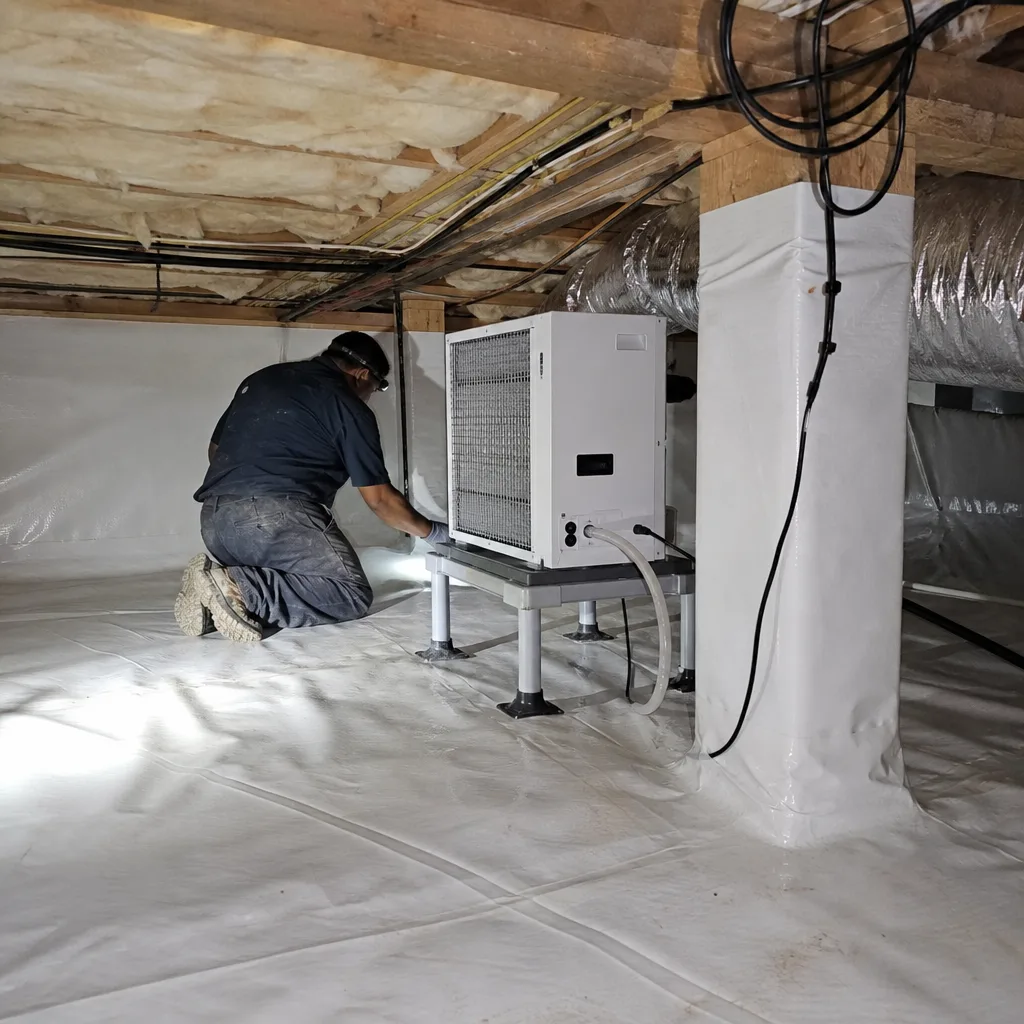
- Crawl space square footage and height: Most New Braunfels homes with crawl spaces run 800 to 1,800 sq ft of ground coverage. At 20 to 24 inches of clearance – common in older Comal County construction from the 1960s and 70s – labor costs climb because technicians are working on hands and knees the entire time.
- Existing moisture damage and mold: The stretch of neighborhoods near Landa Lake and the Comal River see elevated groundwater and humidity during spring flooding. If the crawl space shows active mold or mildew, antimicrobial treatment has to happen before any liner goes down – adding $400 to $1,200 to the job before encapsulation even starts.
- Vent sealing requirements: Older New Braunfels homes were built with open foundation vents under the assumption that outside air would dry the crawl space. Modern building science – and the Texas climate – has largely disproved that theory. Sealing those vents with rigid foam inserts or spray foam is usually part of a complete encapsulation job, and the number of vents (typically 4 to 12 on a standard foundation) affects total cost.
- Old insulation removal: Many homes in New Braunfels, especially those built between 1975 and 1995, have deteriorated fiberglass batts stapled to the underside of the floor joists. That material absorbs moisture, sags, and falls – and it has to come out before proper encapsulation. Removal typically adds $800 to $1,800 depending on the extent and condition.
- Liner thickness and brand: A 6-mil poly is a minimum-grade solution. Most contractors offering a legitimate encapsulation – not just a vapor barrier patch – use 12-mil to 20-mil reinforced liner. The price difference between a 6-mil and 20-mil job can be $800 to $1,500 in materials alone on a mid-sized crawl space.
- Dehumidification and drainage: New Braunfels sits in a humid subtropical climate corridor where summer humidity regularly pushes into the 80 to 90 percent range. A sealed crawl space without mechanical dehumidification can become a humid, stagnant box – especially after the spring storms that come through the Hill Country. Installing a properly sized commercial-grade dehumidifier adds $900 to $2,200 but is often the difference between an encapsulation that performs and one that fails within a few years.
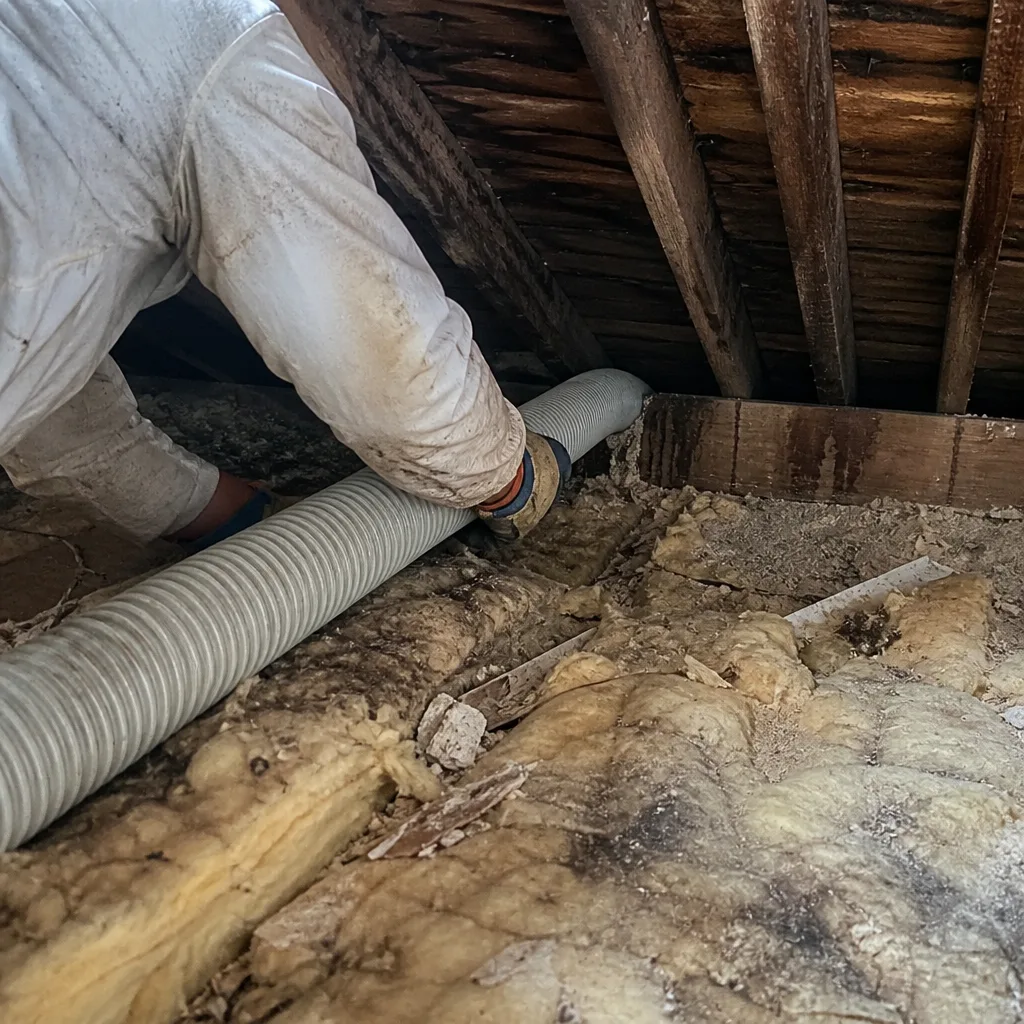 Before
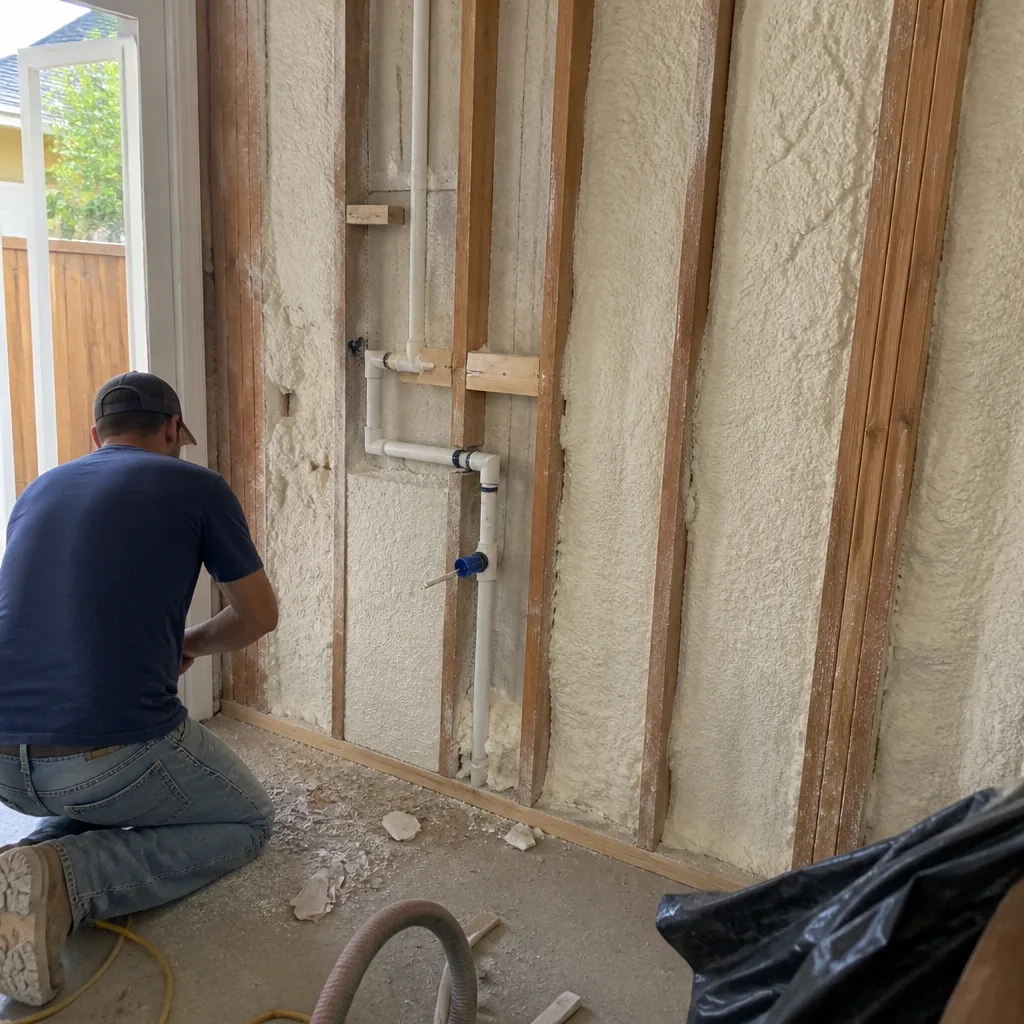 After
AfterHow to Save on Crawl Space Encapsulation & Vapor Barrier
The most effective way to reduce your total cost is to get the job scoped correctly the first time. That sounds obvious, but we see it regularly: a homeowner in New Braunfels hires a contractor for a vapor barrier at $1,400, then six months later calls someone else when moisture is still getting in. A second contractor finds the original liner wasn’t sealed at the walls or vents. The re-do costs more than a proper first installation would have.
A few practical ways to spend less without cutting the wrong corners:
- Combine the encapsulation with insulation work: If you’re also replacing or adding insulation – either in the crawl space rim joists or in the floor above – scheduling it as one visit saves mobilization cost. Spray foam to the rim joists after the liner is installed, for example, completes the thermal envelope in a single crew deployment. Our Crawl Space Encapsulation & Vapor Barrier in New Braunfels service covers both in one scope.
- Address moisture before it becomes mold: If you catch early signs – musty odors, slightly elevated humidity from your HVAC registers, or minor efflorescence on foundation walls – you’re still in the range where standard encapsulation handles it. Wait until there’s active mold, and the job grows by $400 to $1,200 in remediation costs before any liner work begins.
- Get a second opinion on any written estimate: Under the Haven Standard, we offer a free second opinion on any written estimate you bring us. That means we’ll sit down with you, read through the competing scope line by line, and tell you what’s standard, what’s a legitimate upgrade, and what might be unnecessary for your specific crawl space. There’s no pressure to hire us afterward.
- Ask about utility rebates: CPS Energy and some local programs periodically offer rebates for moisture control and home performance improvements. The availability changes, so check directly with your utility provider – but it’s worth a phone call before the job starts.
- Don’t skip the dehumidifier to save money on a full encapsulation: This is the one area where we consistently recommend against cutting costs. A sealed crawl space in the New Braunfels climate that lacks mechanical dehumidification often ends up with higher relative humidity inside the encapsulation than it had with open vents. The dehumidifier is the system; the liner is just part of it.
For a written price on your specific crawl space – square footage, liner grade, vent sealing, and any add-ons you actually need – call us at (830) 243-6352. We don’t give ballpark verbal estimates. The first document you receive from us is a written scope with a flat price attached, before anyone schedules a crew.
Why New Braunfels Crawl Spaces Need More Than a Basic Vapor Barrier
New Braunfels sits at the geological edge between the Edwards Plateau and the Blackland Prairie, which means the soil composition varies considerably even within the city. In Gruene and the older sections near the river, you’ll find expansive clay soils that hold moisture against foundation walls and under slabs. In the newer developments along FM 306 heading toward Canyon Lake, the ground is rockier and faster-draining – but the high humidity from the Guadalupe corridor still finds its way into crawl spaces through gaps in older framing.
This regional characteristic is why a 6-mil poly sheet stapled loosely to the ground is genuinely insufficient here. We regularly see spring failures in crawl spaces on the east side of New Braunfels – particularly in neighborhoods like River Chase and Vintage Oaks – where the liner separated at the wall seams because it wasn’t properly adhered or because ground movement from the clay soils shifted it over time. A properly installed 20-mil liner, sealed at the walls with construction tape and foam at all penetrations, handles that movement.
The other local factor is the spring thunderstorm season. When Comal County gets significant rainfall – and this area averages over 32 inches annually, with much of it concentrated in April and May – the water table rises under crawl spaces quickly. Homes on low-lying lots in the Landa Park area or near the Comal River can see standing water in an unsealed crawl space after a significant rain event. A sump pump, when the lot drainage warrants it, is not an upsell. It’s basic moisture management for that type of site.
Envelope Insulation Co. has been documenting these conditions since 2016, and Wes Okafor’s approach to every crawl space assessment in New Braunfels starts with reading the site: the soil type, the lot grade, the vent placement, the existing insulation condition. That assessment determines what scope actually makes sense – not a menu of packages applied uniformly to every job.
Encapsulation vs. Vapor Barrier: What’s the Actual Difference?
These two terms get used interchangeably in contractor advertising, and they shouldn’t be. The difference is significant in both cost and performance.
A vapor barrier is a sheet of polyethylene film – typically 6 to 10 mil thick – laid on the ground of the crawl space to reduce moisture evaporation from the soil. It covers the floor. It may or may not be taped at seams. Foundation vents typically remain open. It slows ground moisture from entering the crawl space air, but it doesn’t stop conditioned air from escaping or outside humid air from entering through the vents.
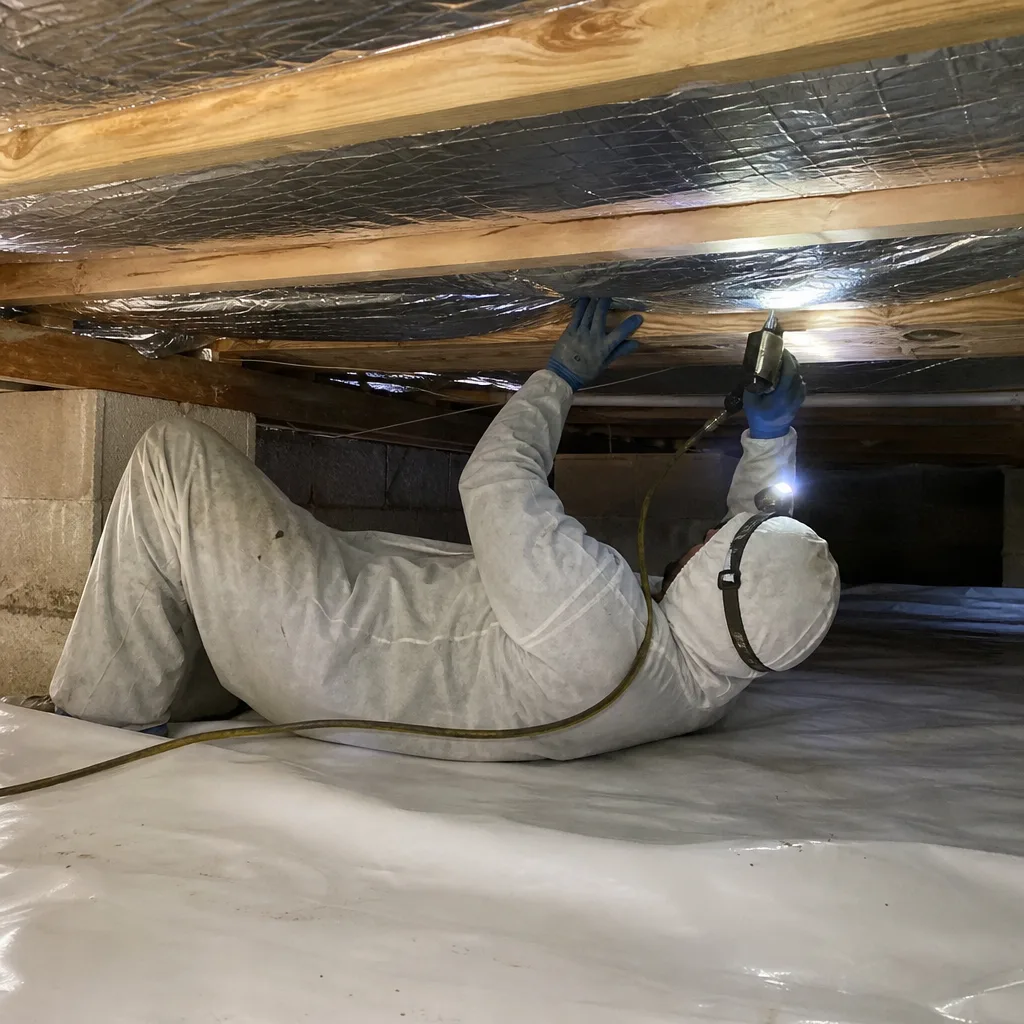
Full encapsulation turns the crawl space into a conditioned (or semi-conditioned) space. The liner covers the ground and runs up the walls and across the piers. All seams are taped airtight. Foundation vents are sealed with rigid foam or spray foam. Rim joists – the band of framing that sits on top of the foundation wall – are insulated, typically with closed-cell spray foam. A dehumidifier manages interior relative humidity. The crawl space becomes part of the home’s building envelope rather than a vented buffer zone.
For most New Braunfels homes, a vapor barrier alone is a partial measure. It reduces ground moisture – that’s real and useful – but it leaves the thermal and air-sealing gaps at the rim joist and vents untouched. If your HVAC ducts run through the crawl space, which they do in many pier-and-beam homes in this area, a vapor barrier does nothing to stop the summer heat load from that unconditioned zone from affecting system efficiency.
The right scope depends on your specific situation. That’s a conversation that starts with a site assessment and ends with a written price – not a number given over the phone before anyone has looked at your specific crawl space.
What the Job Looks Like: From First Visit to Final Documentation
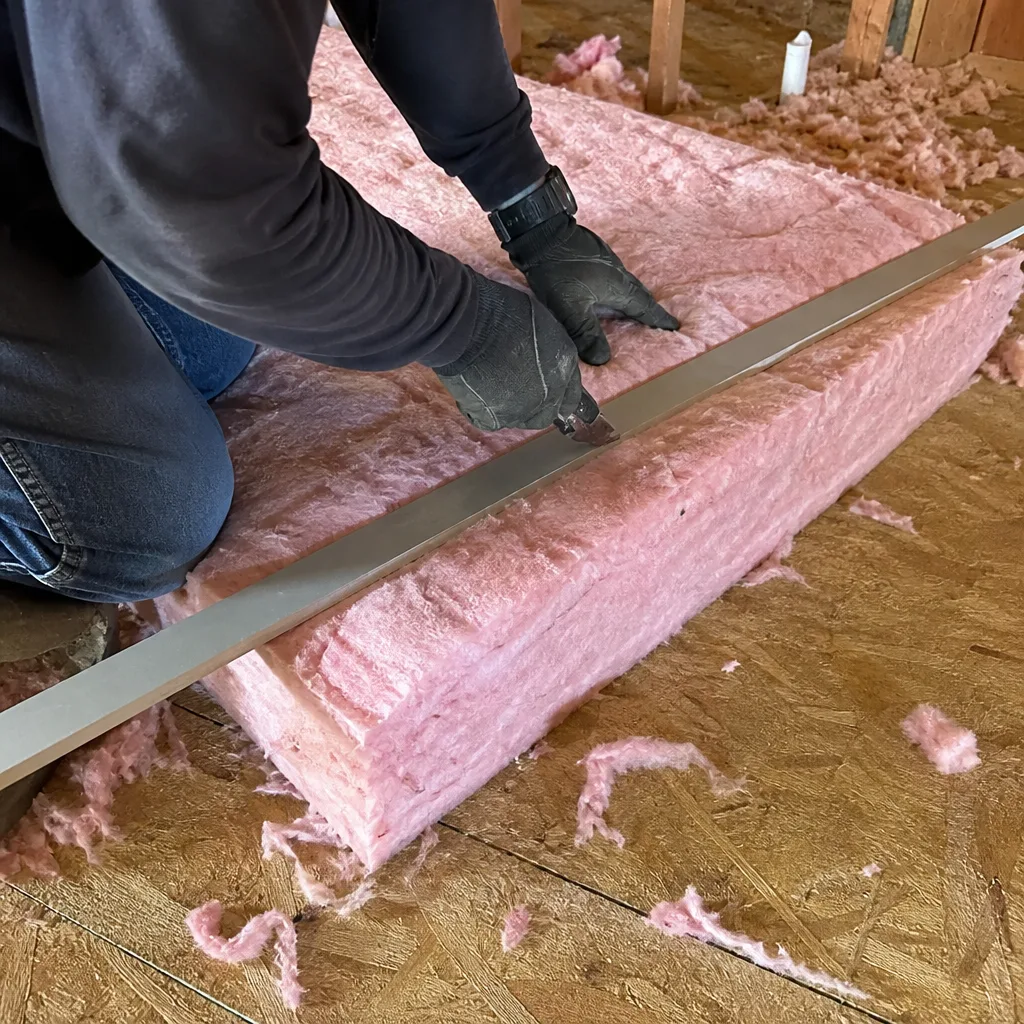
Before any liner rolls out, Wes Okafor or one of our trained technicians does a full crawl space assessment. We’re looking at ground moisture levels, any standing water or staining on the foundation walls, the condition of existing insulation on the floor joists, the number and location of foundation vents, and the rim joist situation. We photograph everything – this is the Documented Photo Record that every job starts with, not an optional add-on.
From that assessment, you get a written scope with a flat price. Under Haven Standard Clause 1, that’s the only way work starts at Envelope Insulation Co. The scope names the liner mil thickness, the coverage area in square feet, the vent sealing method, the rim joist treatment if included, and any add-ons like dehumidifier installation or mold treatment. Nothing is implied. Everything is specified.
On installation day, the crew arrives in uniform and on schedule. You get a text when the technician is on the way – not a four-hour arrival window. The crawl space is cleared of debris, any old insulation that needs to come out is removed and bagged, and if mold treatment was in scope, that happens first and cures before the liner goes down. The liner is run up the walls, adhered at the perimeter, taped at all seams, and cut and sealed around piers and penetrations. Vents are sealed. Rim joists are insulated if that was in scope. If a dehumidifier was included, it’s set and tested before the crew leaves.
When the job closes, you get another set of photos showing the finished installation. Every penetration sealed. Every seam taped. Every vent closed. That’s the Documented Photo Record on exit. You’re not taking our word for the quality of the installation – you’re looking at it.
The 365-Day Done Right Promise covers the completed work. If something isn’t right within that year, we make it right. That’s in writing before any work starts – it’s not a verbal assurance given on the way out the door.
FAQs: Crawl Space Encapsulation & Vapor Barrier Cost in New Braunfels
How much does crawl space encapsulation cost in New Braunfels, TX?
Full crawl space encapsulation in New Braunfels typically costs between $3,800 and $8,500 for a standard residential crawl space, with most jobs in the $5,000 to $6,500 range. That figure includes the liner, seam taping, vent sealing, and rim joist insulation. It does not include a dehumidifier or sump pump, which add $900 to $2,200 and $700 to $1,800 respectively if the site warrants them. Call (830) 243-6352 and we’ll put a written price to your specific crawl space – no guessing required.
Is a vapor barrier the same as encapsulation?
No. A vapor barrier is a polyethylene sheet on the ground that slows soil moisture from evaporating into the crawl space air. It typically costs $1,200 to $2,800 installed. Full encapsulation goes further: the liner runs up the walls, vents are sealed, and the rim joist is insulated – turning the crawl space into a managed space rather than a vented buffer. Encapsulation costs more ($3,800 to $8,500+), but it addresses the thermal and air-sealing gaps that a ground vapor barrier leaves untouched. For most New Braunfels homes with ductwork in the crawl space, the difference in energy performance between the two approaches is measurable.
Is it worth it to encapsulate a crawl space in New Braunfels?
For most pier-and-beam homes in New Braunfels, yes – particularly if the crawl space has standing moisture issues, deteriorated insulation, or HVAC ducts running through it. The payback isn’t purely financial: a properly encapsulated crawl space eliminates the musty odor that migrates into living spaces, reduces the humidity load on the HVAC system, and protects floor framing from the long-term damage that repeated moisture cycles cause. In areas near the Comal River and Landa Lake, where groundwater rises seasonally, encapsulation with a dehumidifier is one of the more effective things a homeowner can do to protect the structure. The question isn’t really whether it’s worth it – it’s whether the scope is right for your specific site. That’s what the assessment determines.
How long does crawl space encapsulation last?
A properly installed 20-mil reinforced liner in a well-maintained crawl space typically lasts 20 to 25 years or more. A 6-mil poly vapor barrier, especially in a high-humidity environment like New Braunfels, can degrade or shift within 5 to 10 years – particularly if there’s foot traffic for plumbing or HVAC service calls. The dehumidifier, if installed, will need filter maintenance and eventual unit replacement on a separate schedule (commercial-grade units typically run 8 to 15 years with regular service). The 365-Day Done Right Promise covers the first year; after that, a periodic visual inspection every 2 to 3 years is good practice.
Can I just put plastic sheeting in my crawl space myself?
You can lay poly sheeting on a crawl space floor – but a DIY vapor barrier at 6-mil does very little if the seams aren’t taped, the edges aren’t sealed at the walls, and the foundation vents remain open. In the New Braunfels climate, that combination leaves most of the moisture pathway intact. The vapor barrier becomes a partial measure that gives the impression of solving the problem without actually closing the building envelope. The portions of the work that carry real risk are primarily the confined-space conditions and the electrical connection for a dehumidifier – both worth having a trained technician handle. If you want a quote on what a complete installation would cost versus what you’d spend on materials alone for a partial DIY barrier, call (830) 243-6352 and we’ll walk through the numbers with you.
Where We Work in and Around New Braunfels
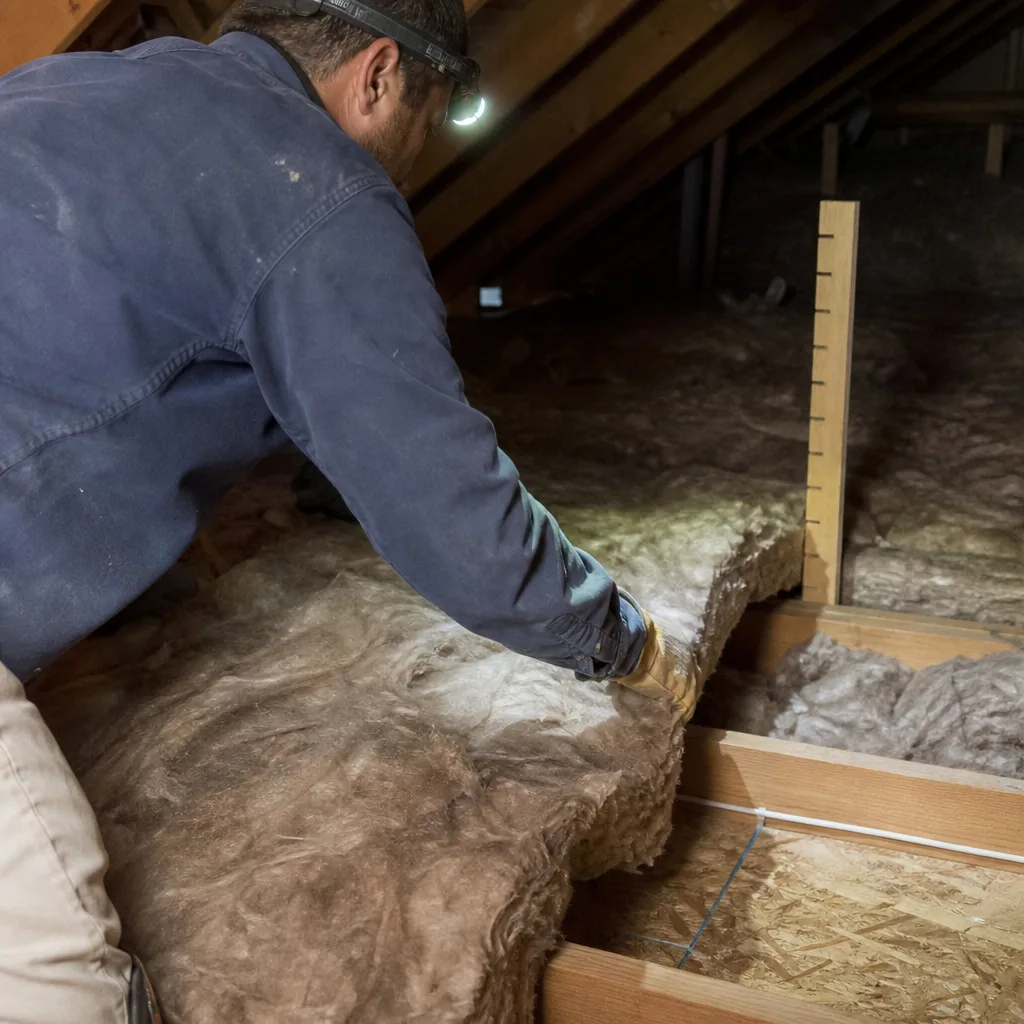
Envelope Insulation Co. serves the full New Braunfels area, including homes in Gruene, Vintage Oaks, River Chase, Landa Park, Solms Road corridor, Hunter Road, Canyon Lake area, and the older residential blocks Downtown. If your home is in Comal County and you have a crawl space, we can assess it. The home page has a full overview of our service lines and coverage area if you want to confirm yours before calling.
We also see a fair number of homes in New Braunfels that were built in multiple phases – an original 1950s or 60s pier-and-beam structure with an addition that’s on a slab. These hybrid foundations require the encapsulation work to be scoped carefully so the liner system addresses both the crawl space zone and the transition points where the two foundation types meet. That’s a detail that often doesn’t show up in a template-quoted job but that matters significantly for moisture control in the finished installation.
Key Takeaways
- Crawl space encapsulation in New Braunfels costs $3,800 to $8,500 for most residential jobs; vapor barrier only runs $1,200 to $2,800.
- A 20-mil reinforced liner outperforms 6-mil poly in the Hill Country’s humid, clay-soil conditions – the material difference is real, not a sales pitch.
- Old insulation removal, mold treatment, vent sealing, and dehumidifier installation are common add-ons in New Braunfels that affect total cost by $400 to $2,200 each.
- A vapor barrier covers only the ground; full encapsulation closes the walls, vents, and rim joist – a meaningfully different scope with a meaningfully different result.
- Every job from Envelope Insulation Co. starts with a written scope and flat price – Haven Standard Clause 1 – and closes with a Documented Photo Record.
- The 365-Day Done Right Promise applies to all completed work, in writing, before anyone starts.
- Wes Okafor leads every assessment personally or with a trained technician who documents conditions before any material is specified.
Pricing reflects the New Braunfels market as of 2026. Topside Attic Insulation New Braunfels offers free estimates – call (830) 243-6352.
Written by Wes Okafor, Owner at Envelope Insulation Co., serving New Braunfels since 2016.
What Our Customers Say
"Crawl space encapsulation done properly. Photographs of the vapour barrier at every seam, and the damp smell in the hallway is gone."
- Ainsley P."They air-sealed the attic floor before insulating and showed me the blower-door number before and after. The upstairs is finally the same temperature as downstairs."
- Marisol D."They photographed rodent damage in the old insulation that we had no idea about, and priced the exclusion work separately so we could decide."
- Harriet N.